Scandi Grind vs Convex Grind: Which is Right for Your Bushcraft Knife?
Quick Answer
A Scandi grind is the best choice for most bushcraft users because it excels at wood carving, is the easiest grind to sharpen in the field, and gives outstanding control for fine tasks. A convex grind is stronger and more durable, making it better for heavy-duty work like batoning and chopping. Your choice depends on whether you prioritise carving precision or brute durability.
What Is a Scandi Grind?
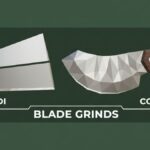
A Scandi grind (short for Scandinavian grind) features a single, flat bevel that runs from partway up the blade directly to the cutting edge. There is no secondary bevel or micro-bevel – the primary grind is the cutting edge.
Picture it this way: if you look at a cross-section of the blade, the sides are flat from the spine down to where the bevel begins. From that point, a single flat plane angles down to the edge on each side. The two bevels meet at the cutting edge, typically at an angle of around 20-25 degrees.
This simplicity is what makes the Scandi grind so effective for bushcraft. The flat bevel acts as its own jig when sharpening – you simply lay it flat on a stone and maintain that contact. No guessing angles, no jigs, no gadgets.
What Is a Convex Grind?
A convex grind has a curved, rounded bevel instead of a flat one. If you look at the cross-section, the sides of the blade curve gently inward towards the edge, like a very shallow lens shape.
Think of it as the opposite of a hollow grind. Where a hollow grind curves inward (concave), a convex grind curves outward. The edge is formed where two convex curves meet.
This curved geometry leaves more steel behind the edge than a Scandi grind at any given point. The result is a stronger, more durable edge that resists chipping and rolling under heavy impacts.
How Does Each Grind Perform for Wood Carving?
Wood carving is where the Scandi grind truly shines, and where the difference between the two grinds is most obvious.
Scandi Grind for Carving
The flat bevel of a Scandi grind registers against the wood surface, giving you precise control over cutting depth. You can feel exactly where the blade is going because the flat bevel provides feedback through the wood.
When making a feather stick, the Scandi bevel glides along the surface of the wood, lifting thin, consistent curls with minimal effort. The flat reference surface makes it almost intuitive – you can feel when the angle is right.
For notch cuts, spoon carving (with a straight knife), and general whittling, the Scandi grind’s predictable behaviour makes it the preferred choice among bushcraft instructors and experienced practitioners.
Convex Grind for Carving
A convex grind can carve wood effectively, but it requires more skill and experience. Without the flat bevel to register against the wood, you are relying entirely on hand feel and muscle memory to control the cut.
The rounded geometry tends to push into the wood rather than glide along the surface. This means deeper, less controlled cuts until you develop the technique to manage it.
Experienced carvers can produce excellent work with a convex grind, but beginners will find the Scandi significantly easier to learn with.
How Does Each Grind Handle Food Preparation?
Both grinds work for food preparation, but their cutting behaviour differs.
A Scandi grind acts almost like a wedge when cutting through food. The flat bevel can cause the blade to steer slightly in dense materials like root vegetables. However, for slicing, dicing, and general camp food prep, it works perfectly well.
A convex grind slices through food more smoothly. The curved geometry parts material efficiently without the wedging effect. If food preparation is a significant part of your outdoor activities, the convex grind has a slight edge here.
Neither grind is a dedicated food preparation tool, though. If camp cooking is a priority, consider the blade thickness and overall geometry as much as the grind type. A thin blade with either grind will outperform a thick blade with the “better” grind.
Which Grind Is Better for Batoning?
Batoning – driving the blade through a piece of wood by striking the spine with a baton – puts enormous stress on the edge.
Convex Grind for Batoning
The convex grind is clearly superior for batoning. The rounded geometry distributes impact forces across a wider area, reducing the risk of edge chipping. The additional steel behind the edge acts as reinforcement, absorbing shocks that would damage a thinner edge profile.
Heavy-duty knives intended for regular batoning are often given a convex grind precisely because of this strength advantage. If splitting firewood with your knife is a regular part of your routine, the convex grind will hold up better over time.
Scandi Grind for Batoning
A Scandi grind can handle batoning, but it is more vulnerable to edge damage during heavy impacts. The transition from the flat of the blade to the bevel creates a stress point, and aggressive batoning can cause micro-chipping along this line.
Many bushcrafters baton occasionally with Scandi-ground knives without issue. The key is using a controlled technique – placing the blade across the wood and striking with moderate, consistent blows rather than trying to split logs with brute force.
If you baton frequently, a convex grind or a Scandi grind with a small secondary micro-bevel will serve you better.
How Easy Is Each Grind to Sharpen?
This is one of the most significant practical differences between the two grinds.
Sharpening a Scandi Grind
The Scandi grind is the easiest grind to sharpen by far. Lay the flat bevel on a stone, maintain contact across the entire surface, and work through your grit progression. The bevel is its own angle guide.
You can achieve a razor-sharp edge in minutes with nothing more than a pocket stone and a strop. In the field, a quick touch-up takes 30 seconds. This ease of maintenance is why the Scandi grind is so popular among bushcrafters who spend extended periods in the woods.
Our complete guide to sharpening a bushcraft knife walks through the full process, including the marker trick for checking your angle.
Sharpening a Convex Grind
A convex grind cannot be sharpened on a flat stone in the conventional way. The curved bevel will not sit flat, and attempting to sharpen it on a flat surface will slowly convert it to a flat grind.
The standard method is to use a leather strop over a slightly compressible surface – a leather pad over a mouse mat, for instance. This allows the leather to conform to the curve. Apply the blade at a low angle, edge trailing, and work both sides evenly.
This works well but requires more skill and attention than Scandi sharpening. You cannot feel a flat surface registering against the stone – you have to judge the angle by hand. Beginners often struggle with this initially.
Some people use slack-belt grinders or curved stones for convex sharpening, but these are workshop tools rather than field equipment.
How Durable Is Each Edge?
Edge durability depends on several factors, but the grind geometry plays a significant role.
Convex edges are more durable. The additional steel behind the edge provides support, making the edge less likely to chip, roll, or fold under stress. This is a simple matter of physics – more material behind the cutting edge means more structural support.
Scandi edges are sharp but more fragile. The thin, flat bevel creates an incredibly keen edge, but there is less material supporting it. Under heavy impacts or when cutting into hard materials (frozen wood, bone, gravel-embedded roots), a Scandi edge is more prone to micro-chipping.
This does not mean Scandi edges are weak. For normal bushcraft use – carving, food prep, processing tinder, light batoning – a well-heat-treated Scandi edge holds up perfectly. It simply has less tolerance for abuse than a convex edge.
The steel type and heat treatment matter as much as the grind. A well-heat-treated O1 Scandi edge will outperform a poorly heat-treated convex edge of any steel. Our guide to bushcraft knife steels explores how steel choice affects edge performance.
Can I Have Both? Compound Grinds Explained
Some makers offer compound or hybrid grinds that combine elements of both geometries.
Scandi with a micro-bevel: A standard Scandi grind with a tiny secondary bevel added at the very edge. This strengthens the edge without significantly affecting carving performance. Many experienced bushcrafters add a micro-bevel to their Scandi knives after experiencing edge chipping.
Convex with a Scandi-style bevel: Less common, but some makers create a convex primary grind with a flat secondary bevel. This gives some of the carving feedback of a Scandi with the strength of a convex geometry.
If you are commissioning a custom knife, discussing grind options with your maker is essential. A good maker will recommend the right geometry for your intended use. Our guide to commissioning a custom knife covers how to have these conversations.
Which Grind Should You Choose?
Here is a straightforward decision guide:
Choose a Scandi grind if: – Wood carving and fine bushcraft skills are your primary activities – You want the easiest possible field sharpening – You are a beginner learning bushcraft knife skills – You value precision and control over brute strength
Choose a convex grind if: – You do a lot of heavy-duty work – batoning, chopping, splitting – Edge durability is your top priority – You are comfortable with the more demanding sharpening technique – You want a knife that shrugs off hard impacts
Choose a Scandi with micro-bevel if: – You want the carving control of a Scandi with added edge durability – You do a mix of fine carving and heavier tasks – You want the best of both worlds (with minor compromises)
For most bushcrafters starting out, a Scandi grind is the right choice. It teaches you good knife skills, it is forgiving to sharpen, and it excels at the tasks that matter most around camp. You can always add a micro-bevel later if you find you need more edge durability.
Frequently Asked Questions
What grind do most bushcraft knives have?
The Scandi grind is the most common grind on bushcraft knives, particularly those from Scandinavian and UK makers. Its ease of sharpening and excellent carving performance make it the default choice for the bushcraft community.
Can I change the grind on my knife?
Technically yes, but it requires significant reshaping and should be done by a skilled maker or sharpener. Converting a Scandi to a convex or vice versa removes a substantial amount of steel and alters the blade geometry permanently.
What angle is a Scandi grind?
Most Scandi grinds are ground at an inclusive angle of 20-25 degrees (10-12.5 degrees per side). Some makers go slightly steeper for added durability or slightly shallower for maximum sharpness.
Is a flat grind the same as a Scandi grind?
No. A flat grind runs from the spine to the edge with no change in angle. A Scandi grind has a flat section from the spine to the bevel shoulder, then a separate flat bevel to the edge. The flat grind creates a thinner overall geometry.
Which grind is better for a beginner?
A Scandi grind is significantly easier for beginners. The flat bevel provides visual and tactile feedback when carving, and sharpening is straightforward because the bevel acts as its own angle guide.
Does the grind affect how strong the blade is?
The grind primarily affects edge strength rather than overall blade strength. A convex grind creates a stronger edge, but blade strength depends more on blade thickness, steel type, and heat treatment.
What grind is best for a survival knife?
A convex grind is generally preferred for survival knives because it handles heavy-duty tasks (batoning, chopping, prying) better than a Scandi grind. However, a Scandi with a micro-bevel is a strong compromise.
Can I sharpen a convex grind on a normal whetstone?
Not effectively. The curved bevel will not sit flat on a flat stone, and you risk converting the grind to a flat profile. Use a strop over a compressible surface, or a slack belt on a grinder.
Which grind holds its edge longer?
This depends more on steel and heat treatment than grind geometry. However, a convex edge generally lasts slightly longer between sharpenings because the additional material behind the edge provides support. A Scandi edge may need stropping more frequently but is quicker to restore.
What grind does Fat Dog Forge recommend?
We recommend the Scandi grind for most bushcraft applications. It is the most versatile, the easiest to maintain, and it excels at the fine tasks that define bushcraft. For heavy-duty field knives and choppers, we offer a convex grind option.